Loading...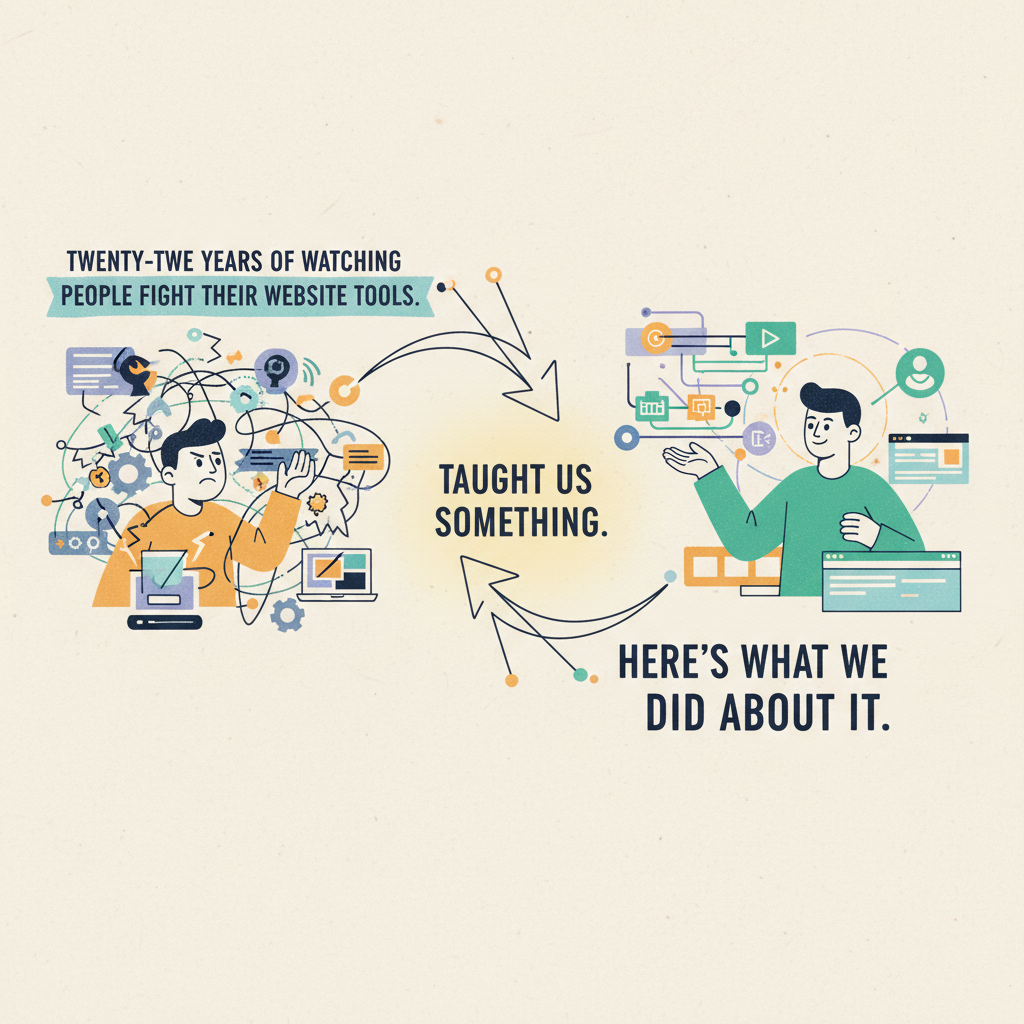
Most "AI website builders" launched eighteen months ago. Web Whatever has been running a content management system since 2004. After two decades of watching real people — pastors, small business owners, nonprofit directors, volunteer webmasters — try to keep their websites alive, the same pattern kept appearing: smart, capable people who knew exactly what they wanted, defeated by the tool that was supposed to help them.
The problem was never that they couldn't figure out how to use a CMS. The problem was that using a CMS was the wrong job to give them in the first place. So Web Whatever did something about it.
The result is a platform that lets you describe what you want in plain language and get a real, fully functional website — built on the same powerful CMS engine that's been running since 2004. Chat to build. Open the hood when you want. And whatever you need, the platform underneath is ready for it.
The Pattern We Couldn't Stop Seeing
A church secretary trying to add a Christmas Eve service to the calendar — three weeks of emails back and forth, eventually just printing a flyer instead. A small business owner who paid a designer to build a beautiful site in 2019 and hasn't touched it since because every edit feels like defusing a bomb. A nonprofit director with a long list of things she'd change if she could ever find ninety quiet minutes and the password.
None of these people were failing at technology. They knew what they wanted. They could describe it in two sentences. What they couldn't do — and shouldn't have to do — is translate "we need a page about our new youth program with a sign-up form and a photo from last year's retreat" into thirty-eight clicks across six different admin screens.
For twenty-two years, the answer was to keep making the admin easier. Better navigation. Cleaner forms. Inline editing. Drag-and-drop. Every release, a little less friction. And every release, the same people kept getting stuck in the same places. We were polishing a doorway that shouldn't have been there.
What Changed
Two things changed at roughly the same time. The first is obvious: large language models got good enough to actually understand what someone means when they say "make the homepage feel more like a Wes Anderson movie." The second is less obvious but more important — Web Whatever already had the CMS. Twenty-two years of it. Pages, events, news, forms, image libraries, recurring schedules, multi-site syndication, member directories — the whole working machine.
The hard part wasn't the AI. The hard part was the platform underneath, and that had already been built. So they connected them.
"The AI doesn't generate a fake website made of pretend HTML. It uses the actual CMS — your fonts, your colors, your real events, your real navigation — and it writes the same kind of pages a human admin would write."
When you describe what you want, the AI doesn't reinvent the wheel. It drives the one that's been refined since 2004.
What This Means in Practice
You can describe a website and get one. That's the headline, and it's true. But the part worth being proud of is what happens next. When you want to edit a paragraph by hand, you can. When you want to chat to add a section, you can. When you want to dive into the full CMS — set up recurring events, manage a people directory, customize design tokens, syndicate news to a partner site — it's all right there.
The AI is a doorway, not a cage. Too many people have been burned by tools that look magical for ten minutes and then trap you when you outgrow them. Whatever you build with the chat is a real website on a real CMS, and you can always open the hood.
What We Believe
Software should meet people where they are. Most people don't want to learn a CMS. They want a website that works, that they can change when they need to, that doesn't make them feel stupid. After twenty-two years, there's finally a way to give them that — without taking anything away from the people who do want the full toolkit.
That's what Web Whatever is. Chat to build. Open the hood when you want. And whatever you need, the platform underneath is ready for it.
Welcome.